Face Swap to Full Video: The AI Toolkit That Held Up in 2026
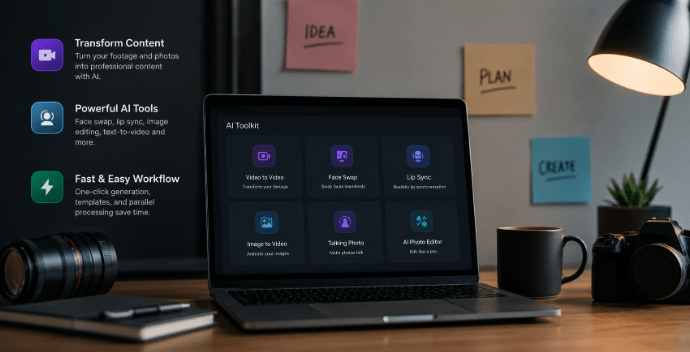
At some point, every creator finds themselves with footage or a photo they want to add different sounds to, a translated voice-over or a synced mouth movement, but most tools will either credit burn through after a few minutes or give a watermark on their output. After testing the top AI content creation platforms this year, I found that finding the best AI lip sync tool free 2026 to use for real projects, Not only demos, but a handful of sites, one of them was definitely very noticeable Magic Hour. It features nine of the most useful tools you’ll want to know, along with face swap, video generation, and photo editing, as well, so you can choose the perfect tool for what you need, not what you think you need.
The 10 Best AI Content Creation Tools at a Glance
| Tool | Best For | Modalities | Free Plan | Paid From |
| Magic Hour | Footage transform, face swap, lip sync, full workflow | Video + Image + Audio | 400 credits, no watermark, no signup required | $10/mo |
| Kling 3.0 | Cinematic text-to-video realism | Video | 66 credits/day, watermarked | $10/mo |
| Runway Gen 4.5 | Character consistency, precision editing | Video | 125 one-time credits | $12/mo |
| Veo 3 / Flow | Native audio-video generation | Video + Audio | Limited via Flow | $19.99/mo |
| Pika 2.5 | Fast, stylized social effects | Video | 80 credits/mo, no watermark | $8/mo |
| Luma Dream Machine | Long-form clip chaining, image-to-video | Video | 30 credits/mo, watermarked | $9.99/mo |
| Seedance 2.0 | Budget native audio-video | Video + Audio | Daily credits via Dreamina | ~$9.60/mo |
| HeyGen | Multilingual avatar videos | Video (Avatar) | 3 videos/mo, watermarked | $29/mo |
| Synthesia | Enterprise avatar training content | Video (Avatar) | Trial only | $30/mo |
| D-ID | Real-time conversational avatars | Video (Avatar) | Short trial | $18/mo |
1. Magic Hour — Best Overall for Footage Transformation and Full Creative Workflows
Taking footage or photos you’ve already taken and turning them into something else, which doesn’t happen with the majority of the tools on this list. Video-to-video style transfer, face swap, lip sync, image-to-video and talking photo are made possible, and there’s an AI photo editor included as well, allowing you to complete one task without switching between five different browser-based accounts.
What convinced me to rank it first, though, is how much you get before paying anything. There’s no signup required just to test it; the free plan hands you a genuinely usable credit allowance with no watermark, and unused credits never expire, a combination I didn’t find anywhere else on this list. Add in click-to-create templates, one-click workflows that chain generation, upscaling, and export together, fast multiple-take variations, and full API parity for developers, and it starts to feel less like a single tool and more like a creative studio.
Strengths
- Best real-footage transformation quality of any browser-based tool I tested
- Face swap, lip sync, and image editing in one workflow, no platform-switching
- Generous free tier: no signup, no watermark, credits that never expire
- Weekly feature releases and access to frontier AI models under one roof
- Parallel generations, meaning no waiting in a single queue
- Reliable even under heavy traffic, and support that actually responds fast
- Works equally well on desktop and mobile
Limitations
- Not built as a standalone text-to-video generator for creating footage from nothing — pairs well with a generative model like Kling for that stage
- Extreme profile angles can occasionally reduce face swap accuracy
Pricing
- Free: No card needed, daily credits, no watermark
- Creator: $15/mo, or $10/mo billed annually ($120/year)
- Pro: $39/mo, with an annual discount available
- Business: $99/mo, with an annual discount available
If you already have footage, photos, or a talking-head clip and want to enhance it without reshooting anything, this is genuinely hard to beat, especially at the $10–15/month range.
2. Kling 3.0 — Best for Cinematic Realism
Kling 3.0 consistently tops 2026 benchmark rankings for photorealistic human motion, and after testing it on several human-focused prompts, it’s easy to see why. The free tier refreshes daily, which makes it one of the more generous ongoing free options for pure text-to-video generation.
Strengths
- Strongest benchmark scores for realistic human characters and motion
- Native audio generation on newer versions
- Videos up to two minutes long, longer than most competitors
- Daily free credit refresh
Limitations
- Paid credits expire without rollover
- Professional mode and audio generation consume credits fast
- Character consistency across separate clips is still inconsistent
Pricing:
- Free (66 credits/day, watermarked)
- Standard $10/mo · Pro $30/mo
- Premier $75/mo
3. Runway Gen 4.5 — Best for Character Consistency
Runway remains the choice for filmmakers who need the same character to look identical across multiple shots and lighting setups. Its Aleph model lets you describe a specific change rather than regenerating an entire clip from scratch, which saves real time in production.
Strengths
- Best character consistency across shots of any model I tried
- Directed editing instead of full regeneration
- Strong documentation and active user community
Limitations
- Sixteen-second maximum per generation
- Credits expire at the end of each billing cycle
- No native audio, so post-production is still required
Pricing:
- Free (125 one-time credits)
- Standard $12/mo · Pro $28/mo
- Unlimited $76/mo
4. Veo 3 / Google Flow — Best for Native Audio Integration
Google’s Veo 3 generates dialogue, sound effects, and ambient audio in the same pass as the video itself, which makes it the strongest option when synchronized sound matters as much as the visuals.
Strengths
- Genuinely synchronized native audio and video
- Strong prompt adherence and realism
- Bundled with the broader Google AI ecosystem
Limitations
- Eight-second generation cap, so longer content needs chaining
- Full quality requires the $249.99/mo Ultra tier
- Workflow is tied entirely to Google’s ecosystem
Pricing:
- Limited free access via Flow
- AI Pro $19.99/mo
- AI Ultra $249.99/mo
5. Pika 2.5 — Best Budget Pick for Social Content
Pika is the most affordable paid option on this list and leans into stylized, effects-driven output rather than photorealism. For fast-turnaround TikTok or Reels content, its effects suite is genuinely useful.
Strengths
- Lowest-cost paid plan on this list
- Free-plan credits roll over instead of resetting
- Distinctive creative effects suite unmatched elsewhere
Limitations
- Five-second maximum generation length
- No native audio
- Not suited to photorealistic or cinematic output
Pricing:
- Free (80 credits/mo)
- Standard $8/mo
- Pro $28/mo
- Fancy $76/mo
6. Luma Dream Machine — Best for Long-Form Clip Chaining
Luma sits between Pika’s speed and Runway’s polish, with a standout extension feature that chains clips into sequences up to five minutes long.
Strengths
- Longest chained output of any tool on this list
- Strong image-to-video motion, particularly for products
- Fast generation, usually under two minutes per clip
Limitations
- Character consistency across separate generations is inconsistent
- Free plan is limited and watermarked
- No native audio
Pricing:
- Free (30 credits/mo)
- Standard $9.99/mo
- Pro $49.99/mo
- Unlimited $94.99/mo
7. Seedance 2.0 — Best Budget Native Audio-Video Model
Seedance accepts text, image, audio, and video simultaneously and outputs both video and audio in one pass, at one of the lowest price points for that capability.
Strengths
- Native audio-video generation at a low starting cost
- Reported success rate above 90%
- Strong multi-shot character consistency
Limitations
- International availability is still expanding
- Interface is less polished than more established platforms
- Fifteen-second generation cap
Pricing:
- Free daily credits via Dreamina
- ~$9.60/mo domestic
- $18–41/mo international plans
8. HeyGen — Best for Multilingual Avatar Videos
HeyGen turns a script into a talking-head video using stock or custom avatars, with lip movement matched to translated audio across more than 175 languages.
Strengths
- Extensive language support with matched lip sync
- Large stock avatar library plus custom avatar creation
- Fast script-to-video turnaround
Limitations
- Free plan is essentially evaluation-only at three watermarked videos
- Built for avatars, not real recorded footage
- Rigid on fast transitions or dynamic scenes
Pricing:
- Free (3 videos/mo, watermarked)
- Creator $29/mo · Business $89/mo
- Enterprise: custom
9. Synthesia — Best for Enterprise Training Content
Synthesia is the enterprise standard for structured instructional video, built around a training-specific framework and used widely for corporate onboarding.
Strengths
- Highly realistic avatars with natural gestures
- Purpose-built templates for training and L&D content
- Strong compliance and data handling for regulated industries
Limitations
- Not designed for creative or cinematic storytelling
- Costs scale up quickly at higher volume
- No meaningful free plan to test first
Pricing:
- Starter from $30/mo
- Creator from $99/mo
- Enterprise: custom
10. D-ID — Best for Real-Time Conversational Avatars
While the company isn’t so well-suited for pre-recorded material, it will work well in real-time, interactive avatars that can engage in live conversations, making it a good match for customer-facing products.
Strengths
- Real-time conversational capability, not just pre-rendered video
- Broad language support for enterprise localization
- API-first design for embedding into products
Limitations
- No ongoing free plan, only a short trial
- Less suited to narrative or cinematic content
- Avatar realism trails Synthesia and HeyGen slightly
Pricing:
- Trial only
- Plans from roughly $18/mo
How We Chose These Tools
They were judged based on the same parameters: Quality to real source content (not cherry-picked), how usable the free plan is, rendering speed, pay transparency, and solving a problem distinctly different to any of the other tools listed here. Where possible tools were tested on the same source clips and prompts making the comparisons more comparable; I’ve double checked all prices on the most recent pricing page of each provider and not based on an old price.
The Market Landscape and Where It’s Heading
It seems that there are three clear lanes of the content creation space from AI—and they are: Generative tools make footage from prompts, avatar platforms dub and dub scripts into actual headshot images and transformation tools enhance footage you already have. Most creators used to pick one tool and stretch it to cover every task. That’s changing, the strongest workflows now stack two or three tools together, using a generative model for raw footage and a platform like Magic Hour to handle face swap, lip sync, and polish afterward. Expect this stacking pattern, along with tighter API access and faster free-tier onboarding, to keep defining the category through the rest of 2026.
Final Takeaway
If you’re starting from existing footage or photos and want the widest toolkit with the strongest free plan, Magic Hour is the clear starting point, and it’s the tool I’d point most creators toward first. For pure cinematic generation from a prompt, Kling 3.0 and Runway Gen 4.5 lead. Veo 3 wins when synchronized audio matters most, Pika 2.5 is the budget pick for social content, and HeyGen or Synthesia make sense once your use case is avatar-based training or multilingual scripts rather than real footage. Whichever combination you land on, test it against your own material before committing to a paid plan, results vary more by content type than most reviews admit.
What’s the best free AI video generator right now?
Magic Hour currently offers the strongest free plans, Magic Hour with no watermark and no signup, Kling with daily refreshing credits.
Is there a free AI face swap tool with no watermark?
Yes, Magic Hour’s free plan includes face swap credits with no watermark and no signup required.
Which AI tool is best for lip syncing a video?
Magic Hour leads for real recorded footage, while HeyGen is better suited to multilingual, avatar-based lip sync.
Can I use AI-generated videos for commercial projects?
Most paid plans allow commercial use, but free tiers on tools like HeyGen and Runway often restrict it, always check the specific plan’s terms.
Do AI video tools work well on mobile?
Magic Hour is optimized for both desktop and mobile; most other tools on this list are desktop-first with limited mobile support.